


In summary:
The Department for Education (DfE) introduced the Multiplication Tables Check (MTC) in 2022. The check must be completed in the first two weeks of June in Year 4 (the academic year in which the child reaches age 9), with a final deadline for submission of results at the end of the third week of June.
The MTC is an online on-screen digital assessment, with scores recorded automatically and made available to school after the assessment window closes.
Whilst school level results of the MTC are not published publicly, each school which administers the assessment receives its own results. Summary PSC results are published at national, regional and local authority level, usually in the November following the June assessment. Parents and carers received a report with their children’s results.
What is the purpose of the MTC?
The DfE states that the MTC ‘focuses on the fluent recall of multiplication facts. This is included in the national curriculum (2014) programme of study for mathematics at key stage 1 and key stage 2. The purpose of the multiplication tables check is to determine whether year 4 pupils can fluently recall their multiplication tables’.
The MTC and the Phonics Screening Check (administered in year 1) are both styled as ‘checks’ rather than ‘tests’.
What is included in the MTC?
The MTC content domain is times tables knowledge up to the 12 times table.
How does the MTC work in practice?
Pupils answer questions on screen on a device. After answering three practice questions, they must answer 25 questions, with six seconds to answer each question.
Each correct answer scores one mark. The maximum score is therefore 25.
There is no pass mark and no nationally defined expected standard.
What do schools get from the process?
The DfE suggests that the MTC helps teachers to “understand which pupils know their times tables” and that it “helps schools identify if children may need additional support”.
Schools receive scores as well as an average score for the cohort.
Publication of MTC results
Schools receive their MTC results once the check has been completed. MTC results are not published publicly at school level but School Inspection Data Summary Reports (IDSRs) include a comparison of the cohort’s average score against the national average. Whilst schools should monitor this measure, the percentage achieving full marks may be more useful when monitoring changing standards over time.
National outcomes are published each Autumn1. These include breakdowns by various pupil groups, including sex, first language, free school meal eligibility, term of birth, ethnicity, SEND and deprivation.
The Multiplication tables check assessment framework (p11) states that ‘there is no expected standard threshold for the MTC’ and ‘ no standard for the MTC beyond the number and percentage of pupils who achieve full marks’.
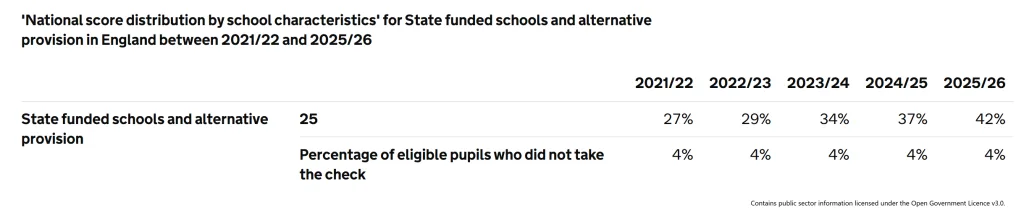
The percentage of pupils scoring 25 marks since 2021/22 is shown below.
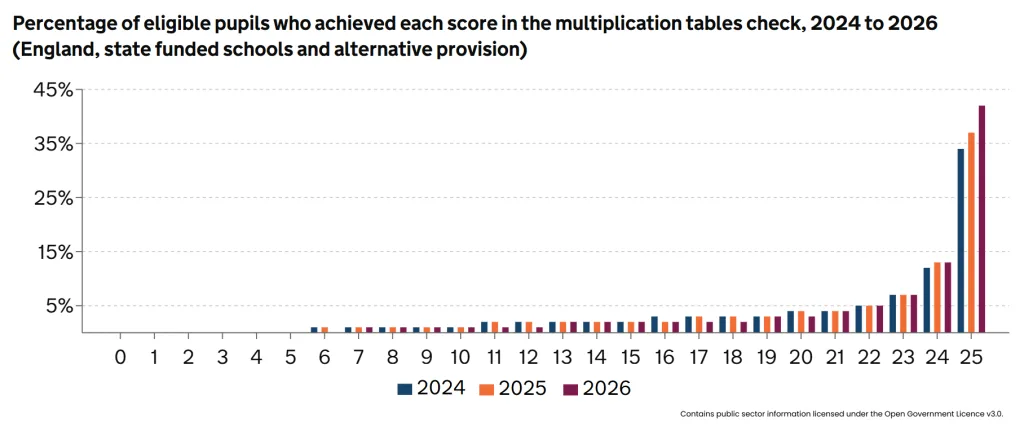
The distribution of scores in 2024-2026 are shown below.
Insight provides Estimated National Statistics, summarising at national level the data which has been entered into the system following the completion of the MTC each June before the official publication of results in the Autumn.
This is the third in our series of posts explaining the key statutory assessments in England. Other posts in the series explain the Phonics Screening Check and the Reception Baseline Assessment.
1 https://explore-education-statistics.service.gov.uk/find-statistics/multiplication-tables-check-attainment/2025-26


Leave a Reply